
Investment trust ownership falls to its lowest level since 2021, as ETFs surge ahead
New research with data-led actions to re-engage trust holders.
17 Aug, 2026


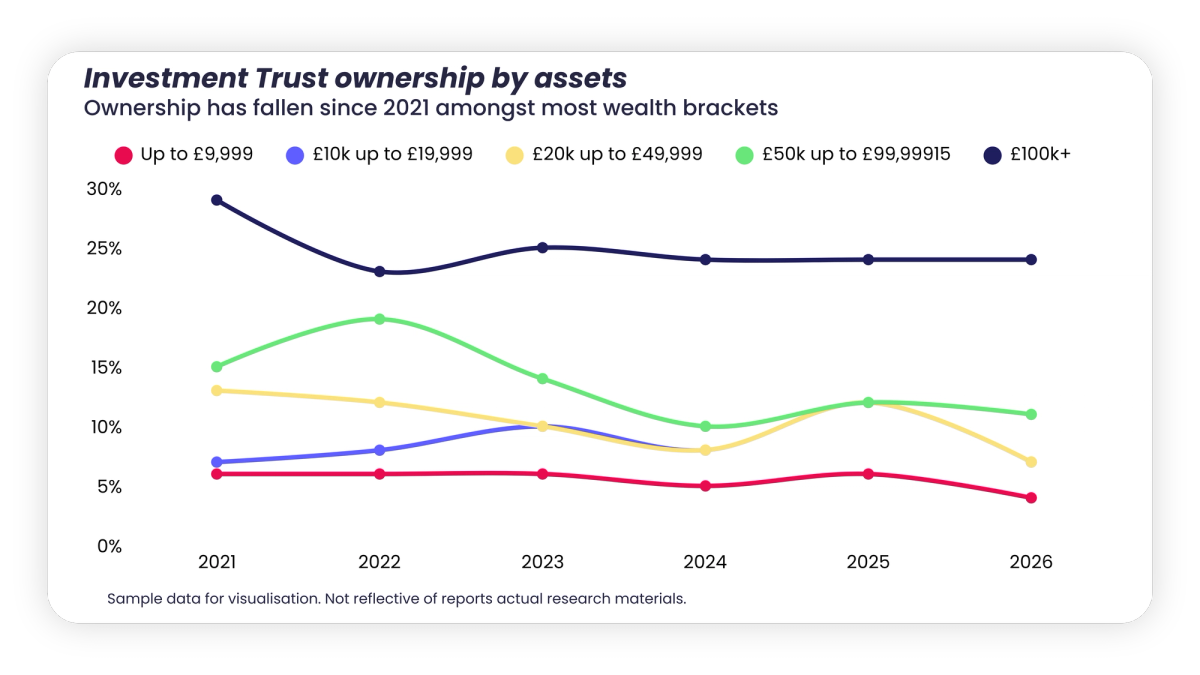
Investment trust ownership among UK investors has dropped to 9%, down from 12% a year ago, the lowest level Boring Money has recorded since it began tracking adoption in 2021. Fund ownership has also slipped, from 23% to 19%, though the longer-term trend for funds has stayed broadly stable. By contrast, ETF ownership has nearly quadrupled since 2020, from 5% of investors in 2021 to 19% today.
Our new Investment Trust Report 2026: Adapting for Growth sets out why investment trusts are losing ground in this growing DIY market, and what asset managers, platforms and distributors can do about it.
A widening but uneven decline
This headline decline masks a more complex picture. The report tracks investment trust, fund and ETF ownership by age and by assets over time, revealing that overall consumer awareness of investment trusts is trailing behind other investment vehicles, such as ETFs. That gap is widest among newer investors, a cohort that rapidly contributed to investment market growth in recent years.

Green shoots among the under-35s
Despite the overall drop, the report identifies a small increase in adoption among under-35 investors. Boring Money CEO and Founder Holly Mackay notes this as an emerging opportunity:
"Interestingly, we have seen a small increase in adoption from the under-35s. To try to capture some of the growth going to ETF providers, investment trusts have more to do to communicate their benefits to a broader investor base which has higher expectations for simple, compelling messaging and competitive price points."
Communication and positioning remain the challenge
Investment trusts, while offering extensive ranges of investment choices, are often misunderstood by the end consumer. This has created a clear adoption barrier for potential investors. It has become another example of supply outpacing consumer demand.
This summer, Boring Money announced our inaugural Rated Provider logos for Investment Trusts. The initiative aims to support consumer choice in this space - we have set out to provide an independent quality mark, assessing trusts against governance, cost, performance and quality of consumer-facing communications. We have had a great response from the industry and are in the process of evaluating the submissions. We will be sharing the results in September 2026.
What this means for asset managers, platforms and distributors
The report sets out that governance, scaling and demonstrable value are the three levers most likely to contribute to improving market share for investment trusts. For platforms and their agencies, that might involve finding communication space for dedicated, segmented investment trust content and shortlists. For asset managers, it means testing whether product features are landing with investors when properly explained. The report finds most investment trust features test as highly attractive once clearly articulated. For both, the under-35 uptick is the most actionable data point in the report: a small, but real signal of where the next generation of investment trust holders could come from if the messaging and positioning meet them where they are.
The report draws on a survey of 6,000 nationally representative UK adults (including 1,717 non-advised investors), 853 DIY platform investors (including 306 investment trust holders), and two further Boring Money panel surveys totalling over 1,200 self-directed investors, alongside test accounts across 40+ UK D2C investment platforms.
Speak to us about how the Investment Trust Report: Adapting for Growth can support your customer adoption, communication and engagement strategies.